
A group of Romanian NGOs developed and pilot Food Hubs as sustainable economic alternatives that can ensure fair market access to small local food producers and individual small farmers.
CONTEXT
Access to markets coupled with basic business know-how, and access to capital are critical elements necessary for the economic development of rural Romania.
After testing cooperatives as one viable market solution for small farmers, RAF partners active in rural development are taking on the challenge to test another model. Food Hubs, as regional facilities, aggregate and market food products at a fair price for both consumers and small farmers, supporting small farmers to promote their produce, providing a healthy alternative to consumers and contributing to the well-being of rural communities.
Food Hubs can be another intermediary for small farmers to reach the market, as well as a resources center for farmers, providing o help increase their competitiveness.
STRATEGY
The program created the framework for testing, learning and adapting the Food Hub model as a means for local economic development to Romania’s context and it was designed to work in two main phases, namely a selection and business planning phase followed by the Food Hub development phase.
- Phase 1: planning (six months) – During the first six months, ten NGOs with expertise in rural development and strong interest in setting-up Food Hubs received support to conduct their local markets research, learn about regulations, look at best practices and ultimately develop business plans. Facilitation, NGO selection and assistance in this phase was provided by CIVITAS.
- Phase 2: implementation of business plans in five regions and start-up consolidation – a selection committee comprised professionals who volunteered their time and expertise selected five Food Hub locations, based on the market research and business plans submitted. RAF provided grants to the five selected organizations to implementthe proposed Food Hub models, providing small farmers with a valid local economic model.
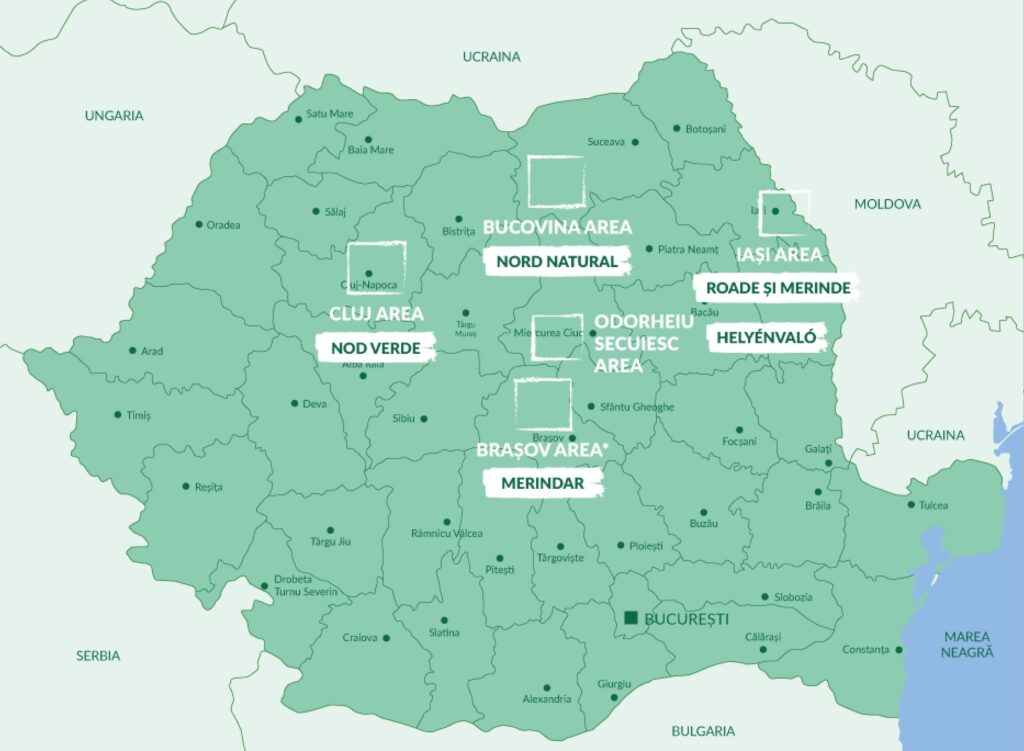
Five organizations worked with small and medium-sized farmers in the following regions to test the food hub model in the market:
- Fundația Open Fields, in the Vatra Dornei area – Nord Natural Hub
- Fundația Centrul de Mediere și Securitate Comunitară (CMSC), in the Iași area – Roade si Merinde Hub
- Fundația Civitas pentru Societatea Civilă, Filiala Cluj Napoca, in the Cluj area – Nod Verde Hub
- Fundația Civitas pentru Societatea Civilă, Filiala Odorheiu Secuiesc, in the Odorheiu Secuiesc area – Helyénvaló Helyit! Hub
- World Vision Romania, in the Brașov area and Ialomița, Vâlcea, Dolj, and Vaslui counties – Merindar (2017-2020)
The Friends for Friends Foundation supported the Food Hubs in the implementation of marketing and sales strategies and in the public communication of the Food Hub concept.
In 2021, CRPE prepared a first report to show the potential of Food-Hubs as a sustainable distribution alternative for small and medium producers and farmers in Romania.
Food Hubs are not just aggregators of local agri-food products, nor simple logistics warehouses, they bring a series of vital services to small and medium-sized farmers, which they cannot get anywhere else at the moment. They need integrated storage-marketing-transportation-consulting-information facilitating the relationship with the consumer-supporting innovation services, which the food hub model delivers by harmonizing the economic objectives, of creating added value for small and medium farmers, with the social ones, which aims at sustainability.
The report at the end of the program completes the 2021 CRPE documentation report with new data and conclusions about the evolution of the pilot project supported by the RAF.